
Chinese brands entering Japan: how to close the trust gap and sell to Japanese buyers
Chinese consumer brands often arrive in Japan with a better product and a lower price, and still struggle. The gap is rarely the product. It is trust, and in Japan trust comes from Japanese proof: a Japanese company behind the brand, Japanese voices, natural Japanese pages and support, and certifications handled properly.
In short: replace "trust our specs" with Japanese proof
Chinese brands sell in Japan when a Japanese company stands behind them, Japanese buyers and media speak for them, the page, manual and support read as native Japanese, and certifications such as PSE are handled by a responsible business in Japan.
By Yuki Nojiri, CEO of Eifer, Inc. (Tokyo). Since 2019 Eifer has launched or supported 58+ overseas brands in Japan.
Why do good Chinese products struggle in Japan?
Many manufacturers from mainland China meet the same pattern in Japan. The factory is strong, the product has patents, the price is competitive, and it sells well at home and on Amazon in other countries. Then it reaches Japan and the first Japanese buyers, retailers or distributors hesitate.
In our experience, Japanese buyers ask three questions before they look at specs:
- Who stands behind this in Japan? If something breaks, who do I call, and will they answer in Japanese?
- Have people like me bought it? Japanese reviews, Japanese creators and Japanese media count far more than overseas ratings.
- Does this brand take Japan seriously? A page that reads like a machine translation, a manual with odd Japanese or a missing Japanese address all say "no".
A strong price does not answer any of these. Leading with price can even make it worse, because it puts your product next to unbranded marketplace items instead of next to the brands Japanese buyers already trust.
The good news: every one of these questions can be answered before you spend heavily on ads. That is what the rest of this page is about.
Five kinds of Japanese proof buyers look for
A Japanese company behind the brand
A Japanese importer or partner name on the page, the label and the invoice, with a Japanese contact
Japanese voices first
Reviews, interviews and use cases from Japanese buyers before any overseas praise
Japanese media and creators
A gadget magazine feature, a YouTube review or a TV segment gives buyers someone familiar to trust
A page and manual written in Japanese
Rebuilt for how Japanese buyers decide, not translated from Chinese or English
Japanese support and warranty
Questions, returns and repairs answered in Japanese, with clear rules written down
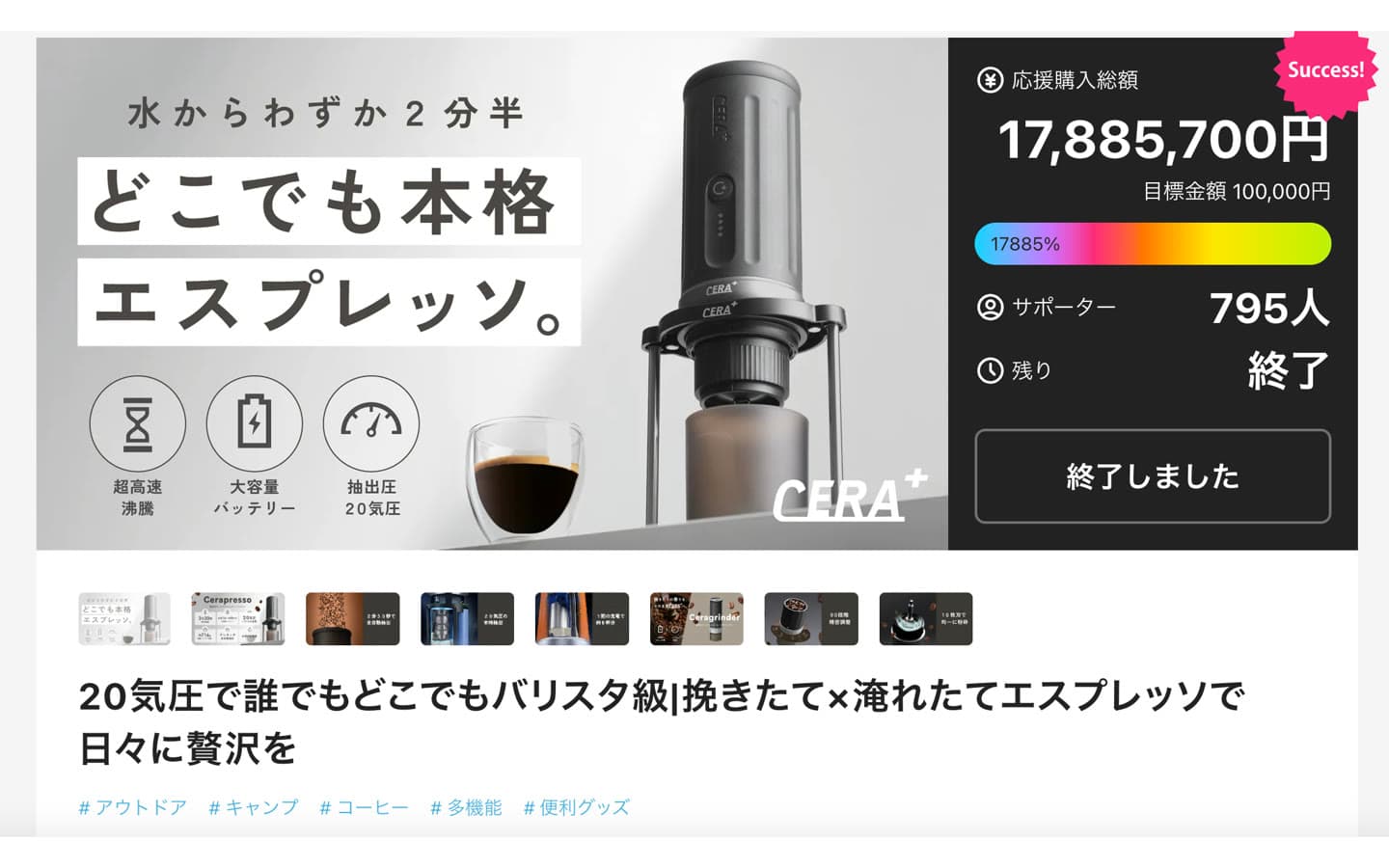
Cera Plus: from struggling to win deals to nearly ¥18M in the first month
Cera Plus is a portable espresso machine made in Zhuhai, China. The brand holds more than 70 patents. On paper it had everything. In practice it had struggled to win deals in Japan.
We fully localized it and rebuilt the brand story for Japanese buyers, then validated it on Makuake, the Japanese crowdfunding platform, before going further. The first month brought nearly ¥18M in sales, and the product was featured in MonoMagazine and Goods Press, two Japanese gadget and lifestyle magazines.
The lesson for other Chinese brands: patents and technical strength are real proof, but only once they are translated into what they mean for a Japanese user in daily life. Once Japanese buyers and Japanese editors were saying it, the same product was received very differently.
Outin: overseas success opens doors, Japanese voices close sales
Outin makes portable coffee makers in Shanghai. Before Japan it already ranked first in its category on Amazon in the US and Europe and sold in 40 countries. We secured the exclusive Japan rights.
A record like that helps in partner conversations. On its own, it does not sell a product to Japanese consumers. Awareness in Japan came from Japanese sources: TV, YouTubers and social media. Within three months of launch, Outin appeared live on Yomiuri TV, and it has been used by a player on Japan's national football team.
Use your overseas numbers to win partners. Use Japanese voices to win buyers.
Who is responsible for PSE and other certifications in Japan?
This is the question Chinese manufacturers most often get wrong, so it is worth being precise. Rules as of November 2026; confirm your own product with METI, MIC, MHLW or a registered certification body.
Electrical products: PSE
Under Japan's Electrical Appliances and Materials Safety Act, the legal duties sit with the manufacturer or importer that notifies the government, not with the factory abroad. That business must notify METI, make sure the product meets Japan's technical requirements, run and record inspections, and put the PSE mark and its own name on the product before sale. METI states that meeting foreign standards does not by itself fulfil these duties, so a CCC, CE or UL mark is not a Japanese approval.
Since December 25, 2025, amended product safety laws also cover overseas businesses that sell covered products directly to Japanese consumers. They are treated as "specified importers" and must appoint a domestic administrator in Japan before they can sell with the mark.
Wireless products: the Radio Act
Products with Bluetooth or Wi-Fi need Japanese technical conformity certification, shown by the Japanese mark (often called "giteki"). Using or selling uncertified wireless equipment in Japan can be illegal.
Food-contact products: the Food Sanitation Act
Kitchen and coffee products that touch food need an import notification at an MHLW quarantine station for each import, and the materials must meet Japanese standards. For one of our coffee products, the Japanese food-safety inspection took about four months and cost about ¥200,000. Plan it into your timeline.
For the step-by-step PSE process and for how to sell in Japan without your own Japanese company, see the related articles below.
How should a Chinese brand price and position itself in Japan?
Price is where many Chinese brands lose the trust they have just built. A few rules make the difference:
- Don't lead with the discount. A headline built on "cheaper than the Japanese brand" invites buyers to compare you with unbranded items. Lead with what the product does, then show the price.
- Show the price the way Japanese buyers expect. Consumer prices in Japan are displayed including consumption tax (10% for most goods). A price that suddenly grows at checkout reads as a trick.
- Keep one price across channels. If the same product is cheaper on a marketplace seller's page, Japanese buyers and retail partners will notice, and the brand looks uncontrolled.
- Offer a complete set. Accessories, a Japanese manual and a clear warranty in the box make a higher price easier to accept than a bare unit at a lower one.
- Protect the name. Check your trademark in Japan before launch, so that the brand Japanese buyers learn to trust is one you own.
None of this needs a lower margin. It needs a price that matches the story the page tells.
What helps a Japanese partner move fast
We work in Chinese and English as well as Japanese, so the factory team and the Japanese team can talk without losing detail.
Whoever you work with, these make the first months faster:
- Sample units early, so Japanese checks and tests can start before any pre-sale.
- Complete technical files for certification, sent once and in one place.
- Raw photo and video files, so Japanese pages and ads can be rebuilt instead of patched.
- One decision maker who can answer in a day. Japanese partners and platforms move on quickly when questions wait a week.
Chinese brands in Japan FAQ
Do Japanese consumers buy Chinese brands?
Yes. Cera Plus sold nearly ¥18M in its first month after full localization, and Outin built awareness through Japanese TV, YouTubers and social media.
Is a CCC or CE mark accepted for PSE in Japan?
No. METI states that meeting foreign standards does not by itself fulfil PSE duties. The Japanese manufacturer or importer must meet Japan's technical requirements and mark the product.
Can a Chinese company sell directly to Japanese consumers?
It can, but since December 25, 2025 an overseas business selling covered products directly must notify as a specified importer and appoint a domestic administrator in Japan. Many brands work through a Japanese importer or partner instead.
Can I work with a Japanese partner in Chinese?
Some partners can. Eifer works in Chinese, English and Japanese.
Related articles

PSE certification in Japan: diamond vs circle PSE, who files, and how long it takes
Which products need PSE, who is legally responsible, what lithium-ion batteries need, and where it fits a launch
Read the article →
Translation doesn't sell in Japan: what to rebuild instead
Lead with one message, localize the proof, and answer the question Japanese buyers ask first
Read the article →Is your brand ready for Japanese buyers?
Book a 30-minute call, in Chinese or English. We will tell you which proof your brand is missing in Japan and which certifications your product needs.
- Minimal upfront cost for your brand
- The form takes about 2 minutes
- We reply within 3 business days