
Japan market entry strategy for consumer brands: five decisions, made in the right order
A Japan market entry strategy for a consumer brand comes down to five decisions: prove demand, choose who runs Japan, localize, certify, then add sales channels one at a time. Brands that struggle in Japan have usually made reasonable decisions in the wrong order, such as signing a distributor before anyone checked demand, or shipping stock before the product was cleared for sale.

In short: demand first, channels last
Prove that Japanese buyers will pay for your product, decide who will import and run it in Japan, rebuild the message for Japanese buyers, clear certifications such as PSE, and only then add channels one at a time. Planned this way, a first launch can often fit into 6 to 12 months.
By Yuki Nojiri, CEO of Eifer, Inc. (Tokyo). Since 2019 Eifer has launched or supported 58+ overseas brands in Japan.
What are the steps of a Japan market entry strategy?
1. Prove demand
Find out whether Japanese buyers will pay, at your price, before you commit stock or rights
2. Choose the entry model
Decide who imports, who holds the certifications and who pays for the launch
3. Localize
Rebuild the message, the proof, the manual and the support for Japanese buyers
4. Certify
Clear PSE, Radio Act, food-contact and trademark questions before the first shipment
5. Sequence channels
Start with one channel that creates proof, then add the next one on top of it
How do you prove demand in Japan before you invest?
Proof means Japanese people paying or committing to pay, not likes, not distributor interest and not a market size figure. The cheapest version is a Japanese landing page, a small ad test that collects sign-ups on LINE, and a pre-order campaign on a Japanese crowdfunding platform such as Makuake, GREEN FUNDING or CAMPFIRE. We cover the mechanics in our article on testing Japanese demand, linked below.
For strategy, the point is what you decide with the result. Set the numbers before you start:
- The most you can pay per sign-up. In our launches a sign-up has cost roughly USD 1 to 3, and around 10% of the list typically buys, more in strong launches.
- The result that means "go": for example, a list big enough that 10% of it covers your first order.
- The result that means "change the message or the target", not "Japan doesn't work". A slow first test usually points to the message or the customer, not the product.
If you skip this step, every later decision is a guess: the partner prices in the risk, the first order is sized by hope, and the channel plan has nothing to stand on.
Which entry model should you choose for Japan?
| Sell directly from abroad | You keep control and margin. You also carry Japanese-language pages, returns, support and delivery times yourself. Fits brands with strong Japanese demand already arriving. |
|---|---|
| Importer or non-exclusive resellers | A Japanese company imports and sells your product alongside others. Fast reach, but nobody is building your brand. Fits products that already sell themselves. |
| Exclusive distribution partner | One partner takes Japan and invests in it. Fits proven products, as long as the contract has minimums, a term and an exit. |
| Partner that funds the launch | The partner buys a first order at wholesale and pays for localization, certification, crowdfunding and ads. Fits brands that want Japan tested without a large budget of their own. |
How to pick between them
Three questions decide the model faster than any comparison chart:
- Who will be the importer in Japan? The importer carries legal duties, for example notifying METI under the PSE rules for electrical products, or filing import notifications for food-contact products. If you have no Japanese company, someone else has to hold this role.
- Who pays for the launch, and who keeps the customer data? Whoever pays for ads and support usually owns the customer list. That list is what makes year two cheaper than year one.
- What happens if it doesn't work? Exclusive rights without performance terms can freeze your brand out of Japan for years.
Our usual model is the last row of the table: we secure exclusive Japan rights, buy a small first order at wholesale, and pay for the Japanese launch ourselves. In our experience, most exclusive deals for Japan are signed without an upfront fee, because the partner puts its money into the launch instead.
What needs to be localized and certified before launch?
Localization: rebuild, don't translate
Japanese buyers often meet your category for the first time, so the page has to answer "what does this do for me?" in one line. Lead with one message, show the product working on video, put Japanese voices before overseas reviews, and make the manual and the support speak natural Japanese. One Japanese launch team told us their biggest regret was using the brand's still key visual instead of a short video: buyers kept asking what the product does.
Price display is part of localization. Consumer prices in Japan are shown including consumption tax, 10% for most goods, so your price ladder has to be built on tax-inclusive numbers.
Certification: check before the first shipment
- Electrical products (PSE): under the Electrical Appliances and Materials Safety Act, the manufacturer or importer notifies METI and makes sure the product meets the technical requirements. Items on the "specified" list also need a conformity assessment by a body registered with METI. Covered products cannot be sold without the PSE mark.
- Wireless products (Radio Act): Bluetooth, Wi-Fi and other radio functions generally need technical conformity certification, shown by the Giteki mark, issued through a body registered with MIC.
- Food-contact products (Food Sanitation Act): importers file an import notification with the health ministry's quarantine stations for apparatus, containers and packaging. On one of our coffee products, the Japanese food-safety inspection took about 4 months and cost about ¥200,000.
- Trademarks: Japan registers trademarks on a first-to-file basis, so file early, and consider the katakana version of your name as well.
- Advertising claims: the Act against Unjustifiable Premiums and Misleading Representations, enforced by the Consumer Affairs Agency, targets claims you can't back up. Drop superlatives you can't prove.
Rules can change, so treat this as a checklist of questions as of November 2026, not legal advice. Confirm your product's status with a registered certification body or a specialist before you order stock.
Which sales channel should you start with in Japan?
Start with one channel that creates proof, then stack the next channel on that proof. The order we use most often:
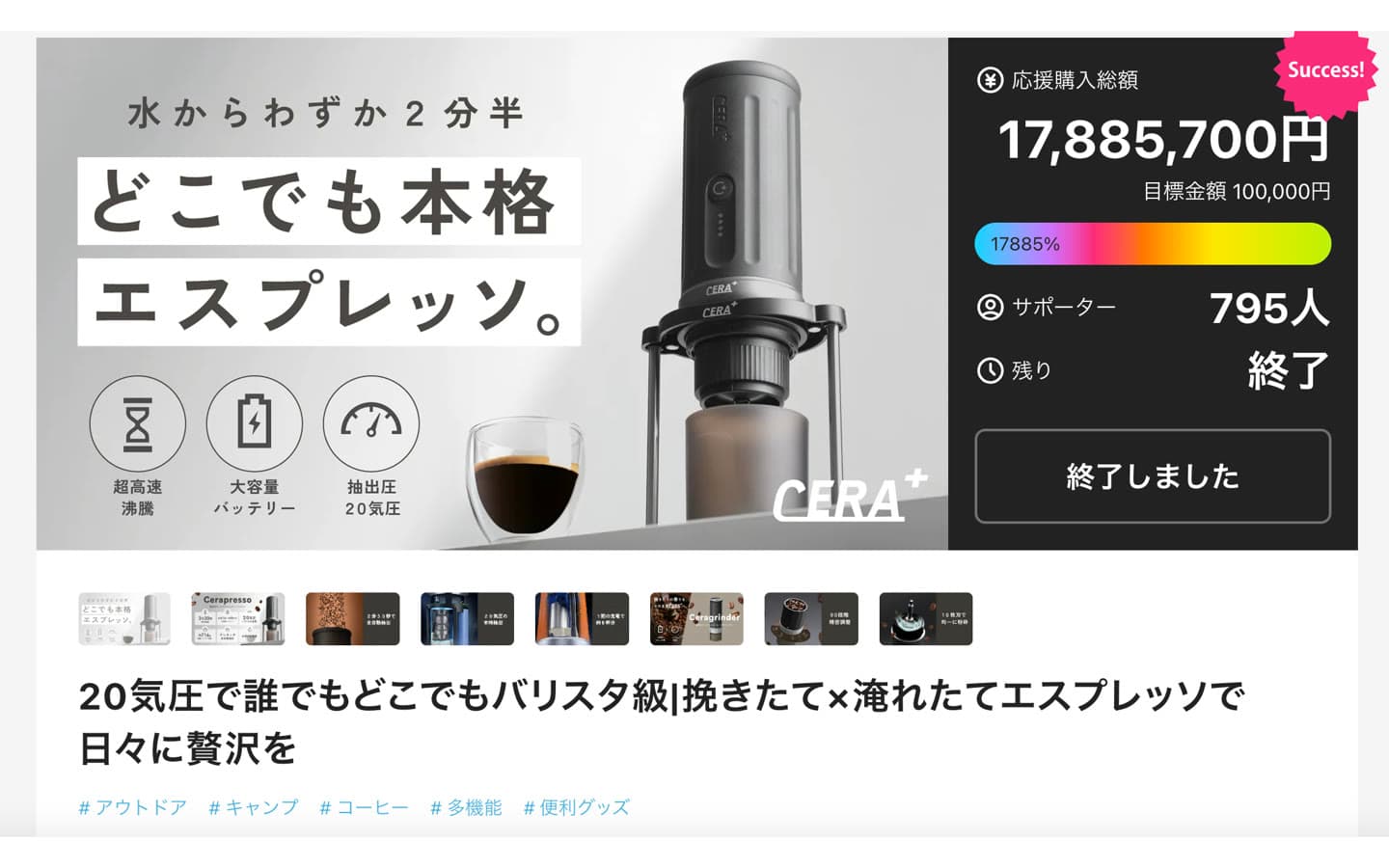
- Japanese crowdfunding first. It works like a pre-order store with an audience: rankings bring in people who have never heard of you, and because it is pre-order, the stock risk is small. Cera Plus, a portable espresso machine from Zhuhai that had struggled to win deals in Japan, was fully localized and validated on Makuake, and sold nearly ¥18M in its first month.
- Then your own store, Amazon and Rakuten. The campaign gives you reviews, photos and a buyer list to bring with you.
- Then media and retail. Results open doors. Cera Plus was featured in MonoMagazine and Goods Press. Outin, a portable coffee maker from Shanghai, built awareness through TV, YouTubers and social media and appeared live on Yomiuri TV within 3 months of launch.
There are exceptions. MUDORA, an Apple Watch band brand from a NASDAQ-listed Israeli company, had sales from the first day of our contract because we could email an existing customer list. If you already have a customer list that can reach Japan, use it first.
A 6-12 month Japan market entry roadmap
| Month 0-1 | Choose the entry model and partner. Check samples. List the certifications the product needs and file the trademark. |
|---|---|
| Month 1-3 | Japanese landing page, small ad test, first buyer interviews. Start certification and any food-contact inspection, which can take months. |
| Month 3-5 | Build the LINE list, shoot the video, write the campaign page. Prepare Japanese manual and support. |
| Month 5-7 | Crowdfunding campaign. In launches we have been part of, campaigns ran from 35 days (AIomi, run by a Japanese partner) to about 64 days (COFFEEJACK, run by a client company we supported). Post updates to backers every few days. |
| Month 7-12 | Ship to backers, open your own store, Amazon and Rakuten, collect reviews, then approach media and retailers with real numbers. |
How fixed is the timeline?
This is a planning assumption, not a promise. Certification lead times stretch it; an existing customer list or an uncomplicated product shortens it. The fastest launch we have seen produced sales in the first week, and one AI gadget from Silicon Valley was signed within a week.
Common Japan market entry mistakes, including ours
- Selling before checking samples. Years ago we pre-sold a Mongolian ger tent before checking samples and refunded about ¥20M. Since then, sample checks and import checks are built into our process.
- Assuming the home-market customer. A Korean coffee appliance we launched on CAMPFIRE was aimed at people in their 20s and raised about ¥4M. Interviews showed the buyers were older. With a rebuilt page and ads, it sold about ¥18M over the next three months on our own online store.
- Translating the home page instead of rebuilding it around one Japanese message.
- Starting certification after the stock is ordered.
- Granting exclusivity before there is any proof, and without performance terms.
- Opening every channel at once. Spreading a small budget over five channels proves nothing in any of them.
Questions to answer before you commit to Japan
We are selective: for every 100 overseas manufacturers we shortlist, we sign with 2 or 3. Questions worth asking yourself before you commit to Japan, one for each decision:
- Can the product be explained in one line in Japanese?
- Who will import it, and who will carry the certifications?
- Does it pass Japanese certification without redesign?
- Does the margin survive Japanese tax-inclusive pricing, channel margins and launch costs?
- Are you willing to let a Japanese team rebuild the message?
Brands also check us. An Asian wellness company that leads its category at home found us through web search and asked us to run its Japan entry. When we asked why they chose us over large agencies, they gave three reasons: we had launched overseas brands in Japan before, they found us while researching, and some other companies only worked in Japanese. We work in English and Chinese as well as Japanese.
Japan market entry strategy FAQ
How long does it take to enter the Japanese market with a consumer product?
As a planning assumption, a launch can often fit into 6 to 12 months from choosing a partner to selling through several channels. Certification and food-contact inspections are the usual reasons it takes longer.
Do I need a Japanese company to sell in Japan?
Not necessarily, but someone in Japan has to act as importer and carry duties such as PSE notification or food import notification. Many brands use a Japanese partner for this role.
Should I start with Amazon Japan or Japanese crowdfunding?
If nobody in Japan knows your brand yet, crowdfunding usually comes first, because rankings bring an audience and pre-orders limit stock risk. If you already have Japanese demand, Amazon and Rakuten can come first.
Do I have to give exclusive rights to enter Japan?
No. Exclusivity makes sense when the partner invests in the launch and the contract has minimums, a term and an exit. Without those, keep it non-exclusive.
Related articles
Makuake for foreign brands: how overseas brands get on Makuake and launch well
Who can list a project, why most brands go through a Japanese partner, what the page needs and why day one decides
Read the article →
Looking for a distributor in Japan? Three ways in, and five questions to ask first
Exclusive partner, channel introductions or selling yourself: how to pick by what you can prove today
Read the article →
How to test Japanese demand before you commit to Japan
A small ad test, a sign-up list and a pre-order campaign tell you more than a market report
Read the article →Which of the five decisions is your brand stuck on?
On a 30-minute call we will go through your product, price and certifications and tell you which entry model and first channel we would choose for Japan, and what we would check first.
- Minimal upfront cost for your brand
- The form takes about 2 minutes
- We reply within 3 business days